
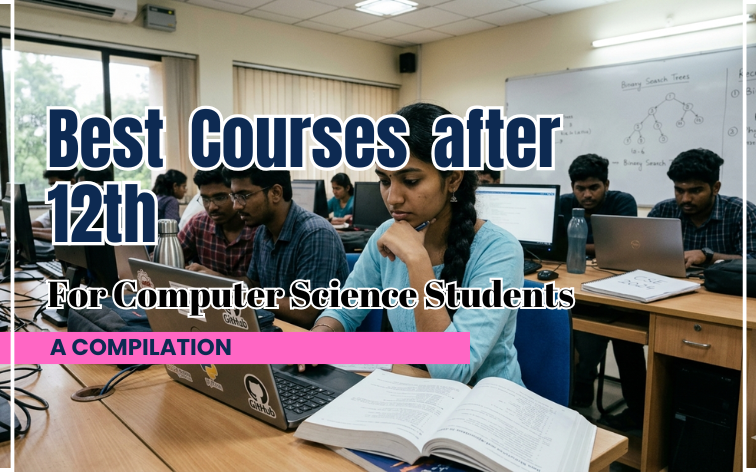
You have studied Computer Science in Classes 11 and 12 – and now the real question is: what next? The good news is that a Computer Science background opens up some of the most exciting, in-demand, and well-paying career paths available to any graduate in India today. From building intelligent software to securing digital networks and working with cutting-edge AI systems, the options are wide – but choosing the right course is what will determine how well your career takes off. This guide covers the eight best courses for Computer Science students after 12th, what each one teaches, and the careers they lead to – so you can make this decision with clarity, not confusion.
At Mahalakshmi Tech Campus, you can get the best tech education – with industry-aligned curriculum, experienced faculty, and strong placement support to back you up.
List of Top 8 Courses for Computer Science Students after 12th
Here are the eight best undergraduate programmes a Computer Science student can pursue after Class 12 – each one designed to build real skills and real career opportunities:
1. B.E. Electrical and Electronics Engineering (EEE)
B.E. EEE teaches you how electricity is generated, transmitted, and converted into useful work – and how electronic systems are designed to control and automate that process. Students with a Computer Science background bring an extra edge in EEE, because modern electrical systems are increasingly software-driven: smart grids, programmable logic controllers (PLCs), SCADA systems, and embedded controllers all require both electrical understanding and programming ability.
The course covers power systems, control engineering, electrical machines, circuit design, and automation. Graduates work in power utilities, electric vehicle companies, renewable energy firms, manufacturing automation, and India’s rapidly expanding EV and solar sectors – careers that combine your CS background with the engineering of the physical world.
2. B.E. Electronics and Communication Engineering (ECE)
ECE sits right at the boundary between hardware and software – a space where your Computer Science skills become a genuine advantage. The course covers electronic circuits, microprocessors, embedded systems, signal processing, communication protocols, and wireless technology. CS students who take ECE often find themselves ahead in programming-heavy modules like embedded C, VHDL, and FPGA design – where the ability to write efficient code is as important as understanding the hardware.
With 5G rollout accelerating across India, IoT devices becoming standard in homes and industries, and semiconductor design gaining national strategic importance, ECE graduates with strong software skills are among the most sought-after engineers in the country. Careers include telecom engineering, embedded systems development, IoT design, VLSI design, and defence electronics.
3. B.E. Computer Science and Engineering (CSE)
B.E. CSE is the natural next step for a student who studied Computer Science in school and wants to go deeper – and it remains the single most in-demand engineering degree in India’s job market. The course builds comprehensively on what you already know: programming languages, data structures, algorithms, computer networks, operating systems, databases, software engineering, and system design.
By final year, a strong CSE student is capable of building software systems, designing databases, architecting cloud solutions, and contributing to large-scale engineering teams. India’s IT sector – home to TCS, Infosys, Wipro, HCL, and hundreds of global MNCs – recruits heavily from CSE every year, alongside product companies like Google, Amazon, and Flipkart. If you love coding and want to work in the core of the technology industry, CSE is your ground zero.
4. B.E. CSE (Cybersecurity)
India processes billions of digital transactions every day – and every single one of them is a potential target. B.E. CSE with a specialisation in Cybersecurity trains you to become the engineer who defends that digital infrastructure. Built on the strong CSE foundation, this specialisation goes deep into network security, ethical hacking, cryptography, penetration testing, digital forensics, and incident response.
Students who studied Computer Science in school already have a head start here – understanding how systems work is the prerequisite for understanding how they can be attacked and protected. India is currently facing a severe shortage of cybersecurity professionals, with demand far outpacing supply across banking, government, defence, healthcare, and corporate sectors. Graduates can pursue roles as Security Analysts, Ethical Hackers, Penetration Testers, Security Operations Centre (SOC) Analysts, and Chief Information Security Officers (CISOs).
5. B.E. CSE (Artificial Intelligence and Machine Learning)
This is one of the most exciting and future-ready specialisations available to a Computer Science student today. B.E. CSE (AI & ML) builds on the core CSE curriculum and adds a deep focus on how machines learn, think, and make decisions. Students study machine learning algorithms, neural networks, deep learning, computer vision, natural language processing, and model deployment. A Class 12 CS background is a real advantage here – Python programming, logical thinking, and mathematics are exactly the foundations this course builds on.
AI & ML engineers are currently among the highest-paid technology professionals in the world, and India’s AI ecosystem is expanding rapidly across healthcare, agriculture, fintech, and manufacturing. Graduates pursue careers as Machine Learning Engineers, AI Researchers, Computer Vision Engineers, NLP Specialists, and Deep Learning Developers at companies ranging from Google and Microsoft to India’s fastest-growing AI startups.
6. B.Tech CSE (Artificial Intelligence and Data Science)
Every organisation today – from a small startup to a national government – runs on data. B.Tech CSE (AI & Data Science) teaches you how to collect, clean, analyse, and interpret that data to drive decisions, build products, and solve real problems. The curriculum covers Python, SQL, R, statistical modelling, data visualisation, machine learning, big data technologies like Hadoop and Spark, and business intelligence tools.
For a student who studied Computer Science in school, this course feels like a natural extension – you already understand how data flows through a system; now you learn what to do with it at scale. Data Science and AI are not limited to the tech sector: banks, hospitals, e-commerce companies, and government departments all need professionals who can make sense of data. Graduates become Data Analysts, Data Scientists, AI Product Managers, Business Intelligence Analysts, and Data Engineers.
7. B.Tech Information Technology (IT)
B.Tech Information Technology is closely related to CSE but with a greater emphasis on how technology is applied within organisations – systems management, networking, database administration, cloud computing, enterprise software, and IT security. While CSE focuses more on computer theory and software engineering, IT focuses on building, maintaining, and securing the technology systems that businesses depend on every day.
For Computer Science students, the programming and problem-solving skills from school translate directly into IT through modules in web development, database design, network administration, and software project management. IT graduates are in demand across every industry – not just in tech companies – because every modern organisation needs people who can manage its technology infrastructure. Careers include System Administrator, Cloud Engineer, Network Engineer, IT Project Manager, and Solutions Architect.
8. Bachelor of Computer Applications (BCA)
BCA is a three-year undergraduate programme that focuses specifically on computer applications – software development, web technologies, database management, programming languages, and application design. For a Computer Science student after 12th, BCA is a focused, practical route into the software industry with a shorter duration than a four-year B.E. or B.Tech degree. The curriculum is application-driven: students build real projects, learn industry-standard tools, and develop hands-on software skills from the very first semester.
BCA graduates can enter the workforce as Junior Software Developers, Web Developers, or QA Engineers – or pursue an MCA (Master of Computer Applications) for deeper specialisation and higher career growth. It is an excellent choice for students who want to enter the tech industry quickly, with a strong practical foundation, and the option to specialise further through postgraduate study.
Conclusion
Computer Science students after 12th are in an enviable position – your background prepares you for eight genuinely excellent undergraduate programmes, each leading to a distinct and rewarding career. Whether you want to build AI systems, secure digital networks, work with hardware, manage data, or develop software applications, there is a course on this list that fits your strengths and your goals. At Mahalakshmi Tech Campus, every one of these programmes is offered with the curriculum, the faculty, and the placement support to turn your choice into a career you are proud of. Choose the course that excites you – and then commit to it fully. The rest will follow.