

 AI agents are transforming how we think about automation and intelligence. Unlike traditional software that simply follows commands, AI agents are autonomous systems capable of perceiving their environment, making decisions, and taking actions to achieve specific goals, all without constant human oversight. They represent a fundamental shift from reactive programs to proactive, goal-oriented systems that can learn and adapt over time. Think of them as digital workers that don’t just respond to your requests but actively work toward objectives you set for them. In this blog, we are going to provide detailed information on AI agents, their working mechanism and the real world examples.
If you are a would-be AI engineer and seeking the course that helps you to realize your potential, then study B.E CSE (Artificial engineering and Machine Learning) in Mahalakshmi Tech Campus to develop your skillsets!
AI Agents – A Brief Overview
At their core, AI agents are software systems designed to operate independently toward specific objectives. Rather than waiting for step-by-step instructions like traditional programs, these agents observe their surroundings, analyze situations, plan appropriate actions, and execute tasks autonomously. What sets them apart is their ability to function without constant prompting while continuously learning from their experiences.
The defining characteristics that make AI agents unique include:
- Autonomy: AI agents operate independently, making decisions and taking actions without requiring human input at every step. Once you set a goal, the agent determines the best path forward on its own.
- Goal-Directed Behavior: Every action an AI agent takes is purposeful, designed to move closer to achieving a specific objective. The agent plans multiple steps ahead, considering various approaches to reach its target.
- Learning & Adaptation: Through feedback loops and experience, AI agents improve their performance over time. They analyze outcomes, identify patterns, and adjust their strategies to become more effective with each iteration.
Understanding the AI agent lifecycle helps clarify how these systems function. The process flows continuously: the agent receives a goal, perceives information from its environment, plans the most effective actions, executes those actions, and then incorporates feedback to refine future decisions. This cycle repeats, creating an intelligent system that grows more capable through experience.
How AI Agents Work
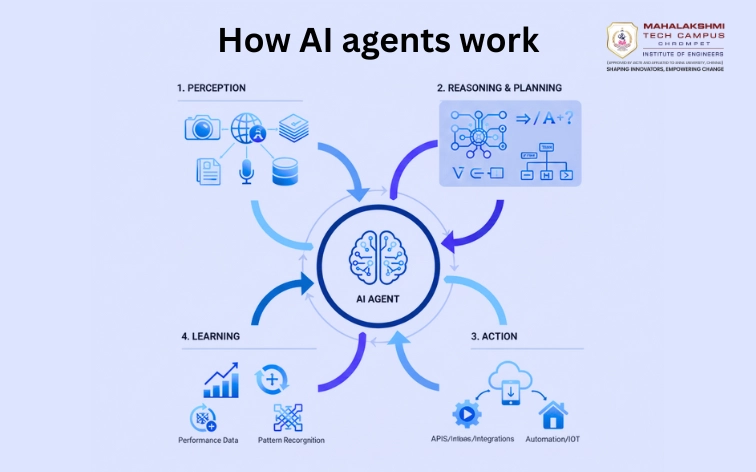
Understanding the inner workings of AI agents reveals why they’re so powerful. The process involves four interconnected stages that work together seamlessly.
Perception: Gathering Information
AI agents begin by collecting data from their environment through various channels. These might include sensors in physical spaces, API connections to digital systems, database queries, user inputs, or real-time data streams. The perception phase is crucial because the quality of information directly impacts the agent’s ability to make sound decisions. Modern AI agents can process multiple data types simultaneously, text, images, numerical data, and even audio, creating a comprehensive understanding of their operating environment.
Reasoning & Planning: Making Decisions
Once an AI agent has gathered information, it moves into the reasoning phase where the real intelligence emerges. The agent evaluates its current situation against its goals, considers multiple potential actions, and calculates the expected outcomes of each option. This involves sophisticated logic systems, utility functions that weigh different outcomes, and planning algorithms that map out sequences of actions. The agent doesn’t just think one step ahead, it considers chains of cause and effect, anticipating how current actions will influence future states.
Action: Executing Tasks
With a plan in place, the AI agent takes concrete actions to achieve its objectives. These actions vary widely depending on the agent’s purpose. An agent might make API calls to other software systems, send communications, manipulate data, control physical devices through IoT connections, or trigger workflows in business applications. The key distinction here is that the agent executes these actions autonomously based on its own decision-making process, not because a human explicitly commanded each specific action.
Learning: Continuous Improvement
The learning phase closes the loop and sets AI agents apart from simpler automation. After taking actions, the agent observes the results and incorporates this feedback into its knowledge base. Did the action produce the desired outcome? Were there unexpected consequences? What could be done differently next time? Through techniques like reinforcement learning, pattern recognition, and outcome analysis, the agent refines its strategies. This means an AI agent deployed today will likely perform significantly better six months from now, having learned from thousands of interactions and decisions.
Key Features of AI Agents
Several distinguishing characteristics define what makes AI agents unique and powerful tools for modern applications.
- Autonomous Decision-Making: AI agents don’t require a human to approve every choice. They evaluate situations independently and select appropriate actions based on their programming, training, and accumulated experience. This autonomy enables them to operate at scale and speed impossible for human-managed systems.
- Goal-Oriented Behavior: Every AI agent is designed with specific objectives in mind. Whether it’s optimizing a supply chain, maintaining customer satisfaction scores, or maximizing portfolio returns, the agent constantly works toward measurable goals. This focus ensures that all activities contribute to meaningful outcomes rather than simply completing arbitrary tasks.
- Multi-Tool Integration: Modern AI agents can interact with numerous systems simultaneously. They might pull data from a CRM, analyze it using analytics tools, make decisions based on business rules engines, and then execute actions across multiple platforms, all within seconds. This integration capability makes them incredibly versatile problem-solvers.
- Memory & Learning Capabilities: Unlike stateless programs that treat each interaction identically, AI agents maintain memory of past events, decisions, and outcomes. They build knowledge bases over time, recognize patterns in historical data, and apply lessons learned to new situations. This memory enables increasingly sophisticated behavior as the agent gains experience.
- Collaboration with Humans and Other Agents: AI agents work alongside people and can even coordinate with other AI agents to accomplish complex objectives. They might handle routine decisions autonomously while escalating unusual situations to human supervisors, or they might divide tasks among multiple specialized agents that each contribute their expertise to a shared goal.
AI Agents vs Chatbots vs Automation
The distinctions between AI agents, chatbots, and traditional automation are significant, though these technologies are often confused.
Feature | AI Agent | Chatbot | Scripted Automation |
Autonomy | Makes independent decisions | Responds to user prompts | Follows predetermined rules |
Learning | Often learns from experience | Rarely adapts beyond updates | No learning capability |
Tool Use | Integrates with multiple systems | Limited to conversation interface | Limited to programmed actions |
Proactivity | Takes initiative toward goals | Waits for user input | Triggers only on specific conditions |
Complexity | Handles multi-step, adaptive tasks | Manages conversations | Executes predefined workflows |
Traditional automation excels at repetitive, rule-based tasks where the conditions and actions are clearly defined in advance. If this happens, do that. Chatbots improve on basic automation by understanding natural language and managing conversations, but they remain fundamentally reactive, waiting for users to ask questions or make requests.
AI agents operate on a different paradigm entirely. They pursue objectives proactively, determining for themselves what actions are necessary. While automation follows scripts and chatbots follow conversations, AI agents follow goals. This distinction becomes crucial when dealing with complex, dynamic environments where predetermined rules can’t account for every possibility.
Real-World Use Cases
AI agents are already transforming operations across numerous industries, delivering tangible results in diverse applications.
- Customer Service Automation: AI agents handle customer inquiries end-to-end, from understanding the problem to accessing relevant account information, troubleshooting issues, processing refunds, and escalating complex cases to human agents. Unlike simple chatbots that provide scripted responses, these agents actually resolve issues by taking actions across multiple systems.
- Business Workflow Orchestration: In enterprise environments, AI agents coordinate complex processes that span multiple departments and systems. They might manage procurement by monitoring inventory levels, predicting demand, generating purchase orders, negotiating with suppliers through APIs, and tracking deliveries—all while optimizing for cost and timing constraints.
- Finance: Trading, Compliance, and Risk: Financial institutions deploy AI agents for algorithmic trading that responds to market conditions in milliseconds, compliance monitoring that flags suspicious transactions according to evolving regulations, and risk assessment that continuously evaluates portfolio exposure across thousands of positions.
- Manufacturing Optimization: On factory floors, AI agents coordinate production schedules, manage equipment maintenance, optimize energy consumption, and respond to supply chain disruptions. They balance competing objectives like minimizing downtime, reducing waste, and meeting production targets while adapting to real-time conditions.
- Smart Environments & IoT: In smart buildings and cities, AI agents manage climate control systems, optimize energy usage based on occupancy patterns and weather forecasts, coordinate security systems, and maintain infrastructure. These agents interact with countless sensors and actuators, making thousands of small decisions that collectively create efficient, responsive environments.
Learn more: Best AI Project Ideas for Students
Benefits & Challenges
AI Agents have lots of potential, yet challenges as well. Here are the key benefits and challenges AI agents may bring:
- Scalability: AI agents can handle workloads that would require armies of human workers. A single agent can manage thousands of simultaneous processes, making them ideal for operations that need to scale rapidly without proportional increases in staff.
- Efficiency Improvement: By operating continuously and making decisions instantly, AI agents eliminate delays inherent in human-dependent processes. They process information faster, don’t need breaks, and maintain consistent performance levels regardless of workload.
- Continuous Operation: AI agents work around the clock without fatigue. This 24/7 availability is particularly valuable for global operations, time-sensitive applications, and services that customers expect to access at any hour.
- Reduced Manual Errors: Human error in repetitive tasks is inevitable. AI agents execute processes with consistent accuracy, following procedures exactly as designed and eliminating mistakes caused by distraction, fatigue, or misunderstanding.
Risks to Consider
- Autonomous Decision Risks: When AI agents make decisions without human oversight, there’s potential for unintended consequences. Security vulnerabilities could be exploited, governance failures might occur if the agent pursues goals in unexpected ways, and the autonomous nature makes it challenging to maintain accountability for decisions.
- Impersonation and Security Concerns: As AI agents become more sophisticated in their interactions, distinguishing between agent and human becomes difficult. This creates opportunities for fraud, social engineering, and security breaches. Organizations must implement robust authentication and transparency measures to ensure stakeholders know when they’re interacting with an AI agent.
- Implementation Complexity: Deploying AI agents successfully requires significant technical expertise, infrastructure investment, and organizational change. Integration with existing systems can be challenging, training agents to perform reliably takes time and data, and organizations must develop new processes for monitoring and governing autonomous systems.
Future of AI Agents
The trajectory for AI agents points toward increasingly sophisticated and widespread adoption across industries.
- Growing Industry Adoption: Organizations that have successfully implemented AI agents are expanding their deployments, while companies previously hesitant about the technology are beginning pilot programs. We’re moving from experimental implementations to production-scale systems that handle critical business functions. Early adopters are seeing competitive advantages that pressure others in their industries to follow suit.
- Regulatory Focus: As AI agents take on more significant roles in business and society, regulatory frameworks are evolving to address their unique challenges. Expect increased attention to transparency requirements, accountability standards, and guidelines for appropriate use cases. Regulations will likely mandate clear disclosure when customers interact with AI agents and establish liability frameworks for autonomous decisions.
- Evolution Toward Multi-Agent Systems: The future isn’t just more capable individual agents but networks of specialized agents collaborating on complex problems. Imagine a supply chain managed by dozens of agents—each responsible for different aspects like demand forecasting, procurement, logistics, and quality control—all coordinating their actions toward shared objectives. These multi-agent systems will tackle problems too complex for any single agent or traditional software system.
Industry leaders are increasingly vocal about AI agents’ transformative potential. The technology is moving beyond experimental stages into practical applications that deliver measurable business value, and this momentum appears poised to accelerate significantly over the coming years.
Frequently Asked Questions
1. What is an AI agent?
An AI agent is a software entity that autonomously performs tasks to achieve specific goals. Rather than simply responding to commands, it perceives its environment, makes decisions about appropriate actions, and executes those actions independently while learning from the results to improve future performance.
2. How is an AI agent different from a chatbot?
The fundamental difference lies in initiative and scope. Chatbots are reactive conversational interfaces that respond to user prompts with information or simple actions. AI agents are proactive systems that pursue goals independently, planning multi-step sequences and taking actions across various systems without waiting for instructions. A chatbot might answer questions about your order status; an AI agent would actively monitor your order, identify delays, contact suppliers, arrange alternatives, and notify you of the resolution.
3. Can AI agents learn over time?
Yes, most modern AI agents incorporate learning mechanisms that allow them to improve through experience. Using feedback loops, they analyze the outcomes of their actions, identify patterns in successful approaches, and adjust their strategies accordingly. An AI agent deployed today will typically demonstrate significantly enhanced performance after months of operation, having refined its decision-making based on thousands of real-world interactions.