


Artificial intelligence requires human intelligence to be brought into life. It must be directed and built with the right intentions for the fruitful impact on the world. Engineering students who are studying Artificial Intelligence must encounter the project work in their college curriculum. More than a credit, it helps you get in touch with AI systems, algorithms, and real-world applications, and boosts your career as well.
Artificial Intelligence (AI) as a field focuses on creating intelligent agents capable of learning, reasoning, and making autonomous decisions similar to human intelligence. As AI project ideas for students become more popular than ever, final-year engineering students often search for easy yet impactful AI projects, AI-based applications, and resume-boosting innovations. Some of the best AI projects for students are AI chatbot, fake news detector, handwriting digit recognition, spam filtering, etc. In this article, you will find the list of 12 best AI project ideas for students with necessary details and instructions.
At Mahalakshmi Tech Campus, we are providing the Artificial intelligence & machine learning course which can build the AI knowledge on the students. Our expert faculty team guides our students to make the project and develop practical intelligence!
Top 12 AI Projects for Students to Learn Practically!
Below, we have given the AI based projects for students along with important details and instructions, which helps you to choose the Artificial intelligence project suitable to you:
- AI Chatbot
- Fake news detector
- Handwritten digit recognition
- Spam filtering
- Object detector
- Sentiment analysis
- Traffic Sign Recognition
- Face detection
- Resume parser
- Stock prediction
- Autonomous vehicles
- Explainable AI
1. AI Chatbot

An AI chatbot is a conversational agent that uses natural language processing (NLP) to understand and respond to user queries in a human-like manner. Students building this project will need Python programming skills, familiarity with NLP libraries like NLTK or spaCy, and knowledge of machine learning frameworks such as TensorFlow or PyTorch. They may also work with pre-trained models like GPT or BERT for more advanced implementations. This project can significantly impact customer service automation, educational assistance, mental health support, and accessibility for users who prefer conversational interfaces over traditional navigation.
How to Build an AI Chatbot?
- Define the chatbot’s purpose and scope – Determine whether it will be rule-based, retrieval-based, or generative, and identify the domain it will serve
- Collect and prepare training data – Gather conversational datasets or create your own dialogue examples with intents and responses
- Choose your development approach – Select between using frameworks like Rasa, Dialogflow, or building from scratch with Python and NLP libraries
- Implement NLP preprocessing – Tokenize text, remove stop words, perform lemmatization, and convert text to numerical representations
- Train your model – Use machine learning algorithms to train on intent classification and entity recognition, or fine-tune a pre-trained language model
- Develop dialogue management – Create logic to handle conversation flow, context maintenance, and multi-turn interactions
- Build the response generation system – Implement template-based responses or use generative models for dynamic replies
- Integrate with a user interface – Connect your chatbot to a web interface, messaging platform, or mobile app
- Test and refine – Conduct extensive testing with real users, collect feedback, and iteratively improve accuracy and user experience
- Deploy and monitor – Launch your chatbot and continuously monitor conversations to identify areas for improvement
2. Fake news detector

A fake news detector is a machine learning system that analyzes news articles, social media posts, and online content to identify potentially misleading or fabricated information. Students will need Python programming skills, understanding of NLP techniques, familiarity with classification algorithms, and knowledge of web scraping to collect data.With this project, students can understand how to handle imbalanced datasets and evaluate model performance using precision, recall, and F1-scores. This project can combat misinformation, promote media literacy, protect public discourse, and help users make informed decisions based on reliable information.
How to Construct a Fake News Detector?
- Gather labeled datasets – Collect datasets of verified real and fake news articles from sources like Kaggle or create your own by fact-checking articles
- Perform data analysis – Analyze text patterns, word frequencies, and characteristics that distinguish fake from real news
- Preprocess the text data – Clean articles by removing HTML tags, special characters, and URLs; perform tokenization and normalization
- Extract relevant features – Implement TF-IDF vectorization, word embeddings (Word2Vec, GloVe), or use BERT embeddings for contextual understanding
- Engineer additional features – Include metadata like source credibility scores, writing style metrics, punctuation patterns, and emotional language indicators
- Split data for training and testing – Create training, validation, and test sets with appropriate ratios, ensuring balanced representation
- Train classification models – Experiment with algorithms like Naive Bayes, Logistic Regression, Random Forest, and deep learning models like LSTM or BERT
- Evaluate model performance – Use cross-validation and metrics like accuracy, precision, recall, and confusion matrices to assess effectiveness
- Implement explainability features – Add mechanisms to show which words or phrases influenced the classification decision
- Create a user interface – Build a web application where users can input articles or URLs to receive credibility assessments with confidence scores
3. Handwritten digit recognition

Handwritten digit recognition is a computer vision project that trains a model to identify and classify handwritten numbers from 0 to 9. Students will need Python programming knowledge, understanding of neural networks, and familiarity with deep learning frameworks like TensorFlow or PyTorch. The famous MNIST dataset serves as the standard training resource for this project. This project has practical applications in automated form processing, check reading in banking systems, postal code recognition, and digitizing historical documents, making it foundational for understanding computer vision.
How to Build Handwritten Digit Recognition?
- Load and explore the MNIST dataset – Import the dataset containing 70,000 labeled images of handwritten digits and examine its structure
- Visualize sample images – Display several examples from each digit class to understand the data’s characteristics and variations
- Preprocess the images – Normalize pixel values to a 0-1 range, reshape images to the required input format, and ensure consistent dimensions
- Prepare labels for training – Convert digit labels to one-hot encoded format for categorical classification
- Design the neural network architecture – Create a CNN with convolutional layers, pooling layers, dropout for regularization, and fully connected output layers
- Configure the model – Select an optimizer (Adam or SGD), loss function (categorical cross-entropy), and evaluation metrics (accuracy)
- Train the model – Fit the model on training data, use validation data to monitor performance, and implement early stopping to prevent overfitting
- Evaluate model accuracy – Test the trained model on unseen test data and analyze the confusion matrix to identify misclassification patterns
- Fine-tune hyperparameters – Experiment with learning rates, batch sizes, number of layers, and epochs to improve performance
- Deploy the model – Create an interactive application where users can draw digits on a canvas and receive real-time predictions
4. Spam filtering


Spam filtering is a text classification project that automatically identifies and separates unwanted or malicious messages from legitimate communications. Students will need Python programming skills, understanding of NLP techniques, and familiarity with classification algorithms. Common libraries include scikit-learn, NLTK, and pandas for data manipulation. This project impacts email security, reduces information overload, protects users from phishing attacks, and improves productivity by filtering out unwanted content across messaging platforms.
How to Build Spam Filtering?
- Collect spam and legitimate message datasets – Use publicly available datasets like the SMS Spam Collection or Enron email dataset
- Preprocess text data – Convert text to lowercase, remove punctuation and special characters, eliminate stop words, and apply stemming or lemmatization
- Extract features from text – Implement TF-IDF vectorization, count vectorization, or n-gram analysis to convert text into numerical features
- Split data into training and testing sets – Maintain class proportions in both sets to ensure representative evaluation
- Optimize using cross-validation – Perform k-fold cross-validation to ensure model generalization and tune hyperparameters
- Evaluate with appropriate metrics – Focus on precision, recall, F1-score, and ROC-AUC, considering the cost of false positives versus false negatives
- Implement and deploy the filter – Create an email client plugin or standalone application that classifies incoming messages in real-time
5. Object detector

An object detector is a computer vision system that identifies and locates multiple objects within images or video streams, drawing bounding boxes around detected items and classifying them. Students will need Python programming expertise, understanding of deep learning, and familiarity with frameworks like TensorFlow, PyTorch, or OpenCV. Pre-trained models like YOLO (You Only Look Once), SSD, or Faster R-CNN provide excellent starting points. This project has widespread applications in autonomous vehicles, surveillance systems, retail analytics, quality control in manufacturing, and assistive technologies for visually impaired individuals.
How to Build an Object Detector?
- Select a detection framework and pre-trained model – Choose between YOLO, SSD, Faster R-CNN, or RetinaNet based on speed and accuracy requirements
- Gather and annotate training data – Collect images relevant to your use case and label objects with bounding boxes using tools like LabelImg or Roboflow
- Prepare the dataset – Organize images and annotations in the required format (COCO, PASCAL VOC, or YOLO format) and split into training, validation, and test sets
- Configure the model architecture – Adjust the network to detect your specific object classes and set appropriate anchor box sizes
- Set up data augmentation – Apply random flips, rotations, scaling, color adjustments, and cropping to increase dataset diversity and improve generalization
- Train the object detection model – Initialize with pre-trained weights, train on your dataset, and monitor loss curves to ensure convergence
- Evaluate detection performance – Calculate precision, recall, and mAP across different IoU thresholds to assess accuracy
- Deploy the detector – Integrate into an application with video feed processing, implement confidence thresholds, and create visualization for detected objects
6. Sentiment analysis
Sentiment analysis is an NLP project that automatically determines the emotional tone behind text data, classifying it as positive, negative, or neutral. Students will need Python programming skills, understanding of text classification, and familiarity with libraries like NLTK, TextBlob, scikit-learn, or transformer models like BERT. Access to labeled sentiment datasets is essential for training. This project impacts brand monitoring, customer feedback analysis, social media marketing, political opinion tracking, and product review systems, helping organizations make data-driven decisions based on public sentiment.
How to Build Sentiment Analysis?
- Define the sentiment analysis scope – Decide whether to classify binary (positive/negative), multi-class (including neutral), or fine-grained sentiments
- Collect labeled sentiment datasets – Use datasets like IMDB reviews, Twitter sentiment, Amazon product reviews, or Yelp ratings
- Explore the data distribution – Analyze sentiment class balance, text lengths, and common expressions in each sentiment category
- Preprocess the text thoroughly – Handle contractions, remove URLs and mentions, normalize text, and consider keeping emoticons as they convey sentiment
- Tokenize and create sequences – Break text into tokens and convert them into numerical sequences for model input
- Choose feature representation – Implement TF-IDF, word embeddings (Word2Vec, GloVe), or use contextual embeddings from BERT
- Build classification models – Train traditional models (Naive Bayes, SVM) or deep learning architectures (LSTM, GRU, BERT fine-tuning)
- Address data imbalance – Apply class weighting or resampling techniques if sentiment classes are unevenly distributed
- Evaluate with relevant metrics – Use accuracy, precision, recall, and F1-score for each sentiment class, along with confusion matrices
- Create a practical application – Develop a web interface or API where users can input text to receive sentiment predictions with confidence scores
7. Traffic Sign Recognition
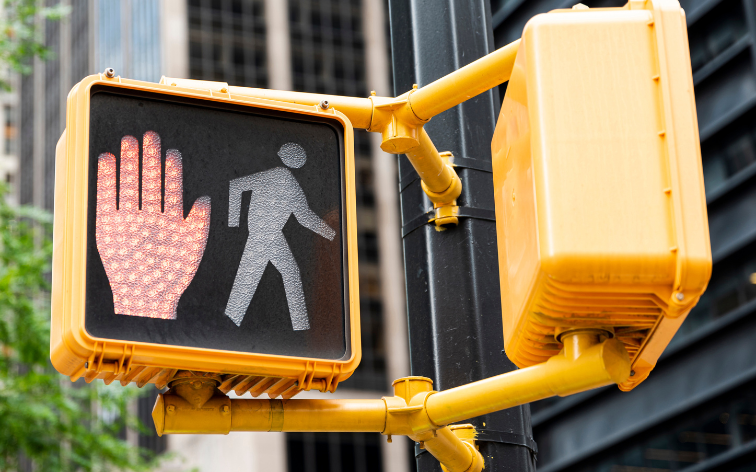
Traffic sign recognition is a computer vision project that trains a model to identify and classify various traffic signs from images, crucial for autonomous driving systems and driver assistance technologies. Students will need Python programming knowledge, understanding of CNNs, and experience with image processing libraries like OpenCV and deep learning frameworks. This project has a direct impact on road safety, autonomous vehicle development, advanced driver assistance systems (ADAS), and can help create accessible navigation tools for drivers.
How to Build Traffic Sign Recognition?
- Obtain traffic sign datasets – Download the GTSRB dataset or similar collections containing thousands of labeled traffic sign images across multiple classes
- Analyze dataset characteristics – Examine the number of classes, class distribution, image quality variations, and lighting conditions
- Preprocess images consistently – Resize images to uniform dimensions, normalize pixel values, and convert to appropriate color spaces
- Implement data augmentation – Apply rotations, translations, brightness adjustments, and perspective transformations to simulate real-world conditions
- Address class imbalance – Use oversampling for underrepresented sign classes or apply class weights during training
- Design a CNN architecture – Create multiple convolutional layers with increasing filters, use batch normalization, and include dropout layers
- Consider transfer learning – Fine-tune pre-trained models like VGG, ResNet, or MobileNet on the traffic sign dataset
- Train with appropriate callbacks – Implement early stopping, learning rate reduction, and model checkpointing to save the best-performing version
- Evaluate classification accuracy – Test on held-out data, analyze per-class performance, and identify commonly confused sign types
- Optimize for real-time inference – Deploy on edge devices, optimize model size, and ensure the system can process video frames with minimal latency
8. Face detection
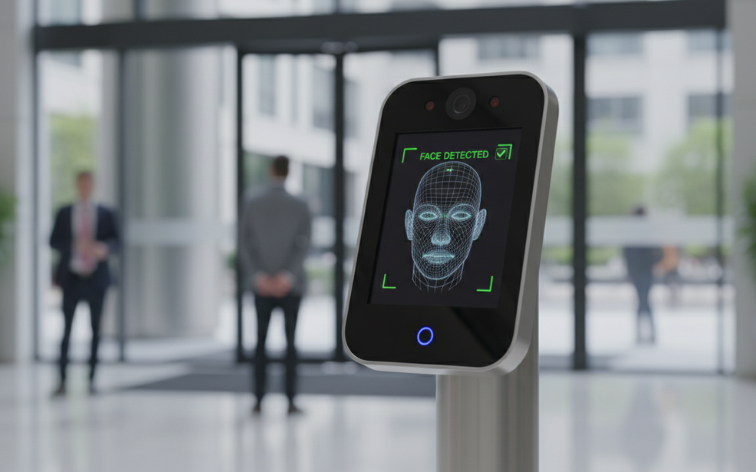
Face detection is a computer vision project that locates human faces within images or video streams, drawing bounding boxes around detected faces regardless of their identity. Students will need Python programming skills, understanding of object detection concepts, and familiarity with OpenCV, dlib, or deep learning frameworks. Pre-trained models like Haar Cascades, HOG-based detectors, or MTCNN provide accessible starting points. This project impacts security systems, photography applications, attendance tracking, human-computer interaction, and privacy-preserving technologies, serving as a foundation for more advanced facial analysis tasks.
How to Build a Face Detection System?
- Choose a face detection method – Select between traditional approaches (Haar Cascades, HOG) or deep learning methods (MTCNN, SSD, YOLO)
- Set up the development environment – Install OpenCV, dlib, or TensorFlow/PyTorch depending on your chosen approach
- Load pre-trained models – Download and configure pre-trained face detection models to avoid training from scratch
- Implement image input handling – Create functionality to load images from files or capture frames from webcams and video files
- Preprocess input images – Convert to grayscale if using traditional methods, resize appropriately, and normalize pixel values
- Apply the detection algorithm – Process images through the detection model to identify face regions with confidence scores
- Draw bounding boxes – Visualize detected faces by drawing rectangles around them and optionally displaying confidence levels
- Implement multi-face detection – Ensure the system can handle multiple faces in a single frame simultaneously
- Optimize detection parameters – Adjust confidence thresholds, scale factors, and minimum neighbor parameters to balance accuracy and speed
- Create a real-time application – Build a video-based system that performs face detection on live camera feeds with minimal latency
9. Resume parser

A resume parser is an NLP-powered system that automatically extracts structured information from unstructured resume documents, including personal details, education, work experience, skills, and certifications. Students will need Python programming expertise, understanding of text extraction, regular expressions, and NLP techniques. This project significantly impacts recruitment automation, reduces manual data entry, improves candidate screening efficiency, standardizes applicant information, and enables better matching between job requirements and candidate qualifications.
How to Build a Resume Parser?
- Define extraction requirements – Identify which fields to extract: contact information, education, work experience, skills, certifications, and languages
- Collect sample resumes – Gather diverse resume samples in various formats (PDF, DOCX, TXT) with different layouts and styles
- Implement document reading functionality – Use libraries like pdfplumber for PDFs and python-docx for Word documents to extract raw text
- Preprocess extracted text – Clean text by removing excessive whitespace, standardizing formats, and handling special characters
- Develop section identification logic – Use keywords, headings, and patterns to segment resumes into distinct sections (education, experience, skills)
- Extract contact information – Apply regular expressions to identify email addresses, phone numbers, LinkedIn profiles, and addresses
- Implement NER for key entities – Use spaCy’s pre-trained models or train custom NER models to identify names, organizations, job titles, and dates
- Parse education details – Extract degree types, institutions, graduation dates, and GPAs using pattern matching and entity recognition
- Extract work experience chronologically – Identify company names, job titles, employment dates, and responsibilities from experience sections
- Structure and store parsed data – Convert extracted information into structured JSON or database format for easy integration with applicant tracking systems
10. Stock prediction

Stock prediction is a time series forecasting project that uses historical market data and machine learning algorithms to predict future stock prices or trends. Students will need Python programming skills, understanding of time series analysis, and familiarity with libraries like pandas, NumPy, scikit-learn, and deep learning frameworks. Knowledge of financial markets and technical indicators enhances the project’s sophistication. While this project has educational value in understanding market dynamics, algorithmic trading, portfolio management, and risk assessment, students should learn that real-world stock prediction faces significant challenges due to market complexity and unpredictability.
How to Build a Stock Prediction Tool?
- Select target stocks and timeframe – Choose specific stocks to analyze and decide on the prediction horizon (daily, weekly, monthly)
- Collect historical stock data – Use APIs like Yahoo Finance, Alpha Vantage, or Quandl to download historical price, volume, and market data
- Explore and visualize the data – Plot price movements, identify trends, and understand volatility patterns and seasonality
- Engineer relevant features – Calculate technical indicators such as moving averages, Bollinger Bands, RSI, MACD, and momentum indicators
- Incorporate external factors – Consider adding sentiment data from news, economic indicators, or market indices as additional features
- Prepare sequential data – Create time-windowed samples where previous days’ data is used to predict future values
- Normalize the data – Apply scaling techniques like MinMaxScaler to ensure features are on comparable scales for neural networks
- Build prediction models – Implement LSTM or GRU networks for capturing temporal dependencies, or try ensemble methods combining multiple approaches
- Train with appropriate validation – Use time-based splitting (not random) to maintain temporal order and prevent data leakage
- Evaluate predictive performance – Use metrics like RMSE, MAE, and directional accuracy, while acknowledging the inherent limitations of stock prediction.
11. Autonomous vehicles

Autonomous vehicles represent a comprehensive AI project that integrates computer vision, sensor fusion, path planning, and control systems to enable self-driving capabilities. Students will need advanced programming skills in Python and C++, understanding of robotics, machine learning, and access to simulation environments like CARLA, AirSim, or physical platforms like NVIDIA Jetson. This is typically a team project given its complexity. This project has a transformative impact on transportation safety, reducing accidents, improving traffic flow, providing mobility solutions for those unable to drive, and reshaping urban planning.
How to Build an Autonomous Vehicles Project?
- Define the project scope – Start with specific capabilities like lane keeping, obstacle avoidance, or parking, rather than full autonomy
- Choose a simulation platform – Set up environments like CARLA, AirSim, or Gazebo for safe testing without physical hardware
- Implement perception modules – Develop or integrate lane detection, traffic sign recognition, and object detection systems
- Set up sensor simulation – Configure virtual cameras, LiDAR, radar, and GPS sensors to mimic real-world autonomous vehicles
- Develop localization systems – Implement GPS integration and SLAM algorithms to determine the vehicle’s position and build environmental maps
- Create path planning algorithms – Design systems to generate safe, efficient trajectories from current location to destination while avoiding obstacles
- Implement decision-making logic – Develop behavior planning that handles traffic rules, right-of-way, and interaction with other vehicles
- Build control systems – Create PID controllers or model predictive control to execute planned trajectories through steering and throttle commands
- Test in progressive scenarios – Begin with simple straight-line driving, progress to turns, then add traffic, pedestrians, and complex intersections
- Consider safety and ethics – Implement fail-safe mechanisms, emergency braking, and study ethical decision-making frameworks for unavoidable collision scenarios
12. Explainable AI

Explainable AI (XAI) focuses on developing machine learning systems that can provide human-understandable explanations for their predictions and decisions, addressing the “black box” problem in AI. Students will need strong Python programming skills, deep understanding of machine learning models, and familiarity with XAI libraries like LIME, SHAP, InterpretML, or ELI5. This project works best when applied to an existing predictive model. This project has a critical impact on building trust in AI systems, ensuring regulatory compliance (especially in healthcare and finance), detecting model bias, debugging model errors, and enabling human-AI collaboration in high-stakes decisions.
How to Build Explainable AI Software?
- Select a base prediction model – Choose an existing model to explain (image classifier, credit risk predictor, medical diagnostic system)
- Understand the model’s architecture – Analyze inputs, outputs, layers, and decision-making process of the model you’re explaining
- Implement SHAP analysis – Use SHapley Additive exPlanations to calculate feature importance and understand how each input contributes to predictions
- Integrate LIME for local explanations – Apply Local Interpretable Model-agnostic Explanations to explain individual predictions with simplified surrogate models
- Create feature importance visualizations – Develop charts, heatmaps, and graphs showing which features most influence model decisions
- Implement attention visualization – For deep learning models, visualize attention weights to show which parts of inputs the model focuses on
- Generate counterfactual explanations – Show users how changing specific inputs would alter predictions, helping them understand decision boundaries
- Develop natural language explanations – Convert technical explanations into plain language that non-experts can understand
- Build an interactive dashboard – Create a user interface where stakeholders can input data, receive predictions, and explore explanations interactively
- Validate explanation quality – Test explanations with domain experts and users to ensure they’re accurate, useful, and truly improve understanding
Conclusion
As you step into your academic project journey, treating AI with the right intent, direction, and responsibility mentioned earlier becomes essential. Working on artificial intelligence projects not only deepens your understanding of intelligent systems but also equips you with practical skills that shape your future career. By choosing the right AI project, you bridge the gap between theoretical learning and real-world innovation, setting yourself apart in a field that demands creativity, problem-solving, and purposeful technological impact. Good luck to all of your endeavours!
Explore Project Guides for Other Engineering Streams
- Top 12 Mini Project Ideas for ECE Students
- Top 20 Mini Project Ideas for CSE Students
- Data Science Project Ideas for Final Year Students
- Top Final year project ideas for CSE Students
- Top 15 Projects for EEE Engineering Students
- Top 25 Cybersecurity Projects for Students