

Electronics and Communication Engineering (ECE) is a branch of engineering that deals with electronic devices, circuits, and communication systems. It involves the study of how we design, develop, and maintain systems that help people communicate and share information. This field has made a huge impact on the world by giving us smartphones, the internet, satellite communication, and wireless networks. ECE engineers created inventions like mobile phones, computers, GPS systems, and television that changed how we live and work. In this “What is Electronics and Communication Engineering (ECE)” blog, we are going to see the evolution, core concepts, and career applications involved in the ECE field.
A Short History of Electronics and Communication
Before electronics and communication engineering existed, people used basic methods like telegraphs and wired telephones to send messages over distances.
The journey began in the late 1800s when inventors discovered how to use electricity for communication. In 1876, Alexander Graham Bell invented the telephone, which let people talk to each other across distances for the first time. Then in 1904, John Fleming invented the vacuum tube, which became the heart of early electronics. This opened doors for radio communication and broadcasting. The field grew rapidly in the 1900s with the invention of transistors in 1947, which made electronic devices smaller and more reliable. After this came integrated circuits in the 1950s, computers, mobile phones in the 1980s, and the internet in the 1990s.
Today, ECE has transformed our world into a connected place where we can instantly communicate with anyone, anywhere. The field continues to grow with new technologies like 5G networks, artificial intelligence, and smart devices that make our lives easier and more connected.
Definition and Scope of ECE
Definition: Electronics and Communication Engineering is a field that studies electronic devices, circuits, and systems used for transmitting and receiving information across various channels like cables, radio waves, and optical fibers.
Scope: The scope of ECE is vast and growing. It covers everything from designing computer chips and mobile phones to building communication networks and satellite systems. ECE engineers work in industries like telecommunications, consumer electronics, healthcare, aerospace, automotive, and defense, making it one of the most versatile engineering branches.
Core Concepts and Principles of ECE
Below we have listed the core concepts and principles of ECE which help us clearly understand what Electronics and Communication Engineering is:
Circuit Theory
Circuit theory teaches us how electrical components like resistors, capacitors, and inductors work together in a circuit. It helps engineers understand how electricity flows through devices and how to design circuits that perform specific tasks. This is the foundation for building any electronic device, from simple flashlights to complex computer systems.
Signal Processing
Signal processing is about analyzing and manipulating signals to improve their quality. Signals carry information in forms like sound, images, or data. Engineers use signal processing to remove noise from phone calls, compress video files, enhance medical images, and make voice assistants understand what we say. This concept is essential for all modern communication systems.
Electromagnetic Theory
Electromagnetic theory explains how electromagnetic waves behave and travel through space. This knowledge is crucial for designing antennas, understanding how mobile phones connect to towers, and creating wireless communication systems. Without this principle, we wouldn’t have radio, television, Wi-Fi, or satellite communication.
Digital Electronics
Digital electronics deals with circuits and systems that work with digital signals (represented as 0s and 1s). This is the technology behind computers, smartphones, and all digital devices we use today. Understanding digital electronics helps engineers create memory chips, processors, and control systems that power our digital world.
Communication Systems
Communication systems are networks that enable the transfer of information from one place to another. This includes understanding how data is sent through cables, wireless networks, satellites, and fiber optics. Engineers learn to design reliable communication systems that connect the world, making video calls, internet browsing, and instant messaging possible.
Microprocessors and Microcontrollers
Microprocessors are the “brains” of computers and smartphones, while microcontrollers are used in everyday devices like washing machines, cars, and air conditioners. These tiny chips process information and control how devices function. Understanding them is vital for creating smart devices and automated systems.
Learn more: 12 Mini Project Ideas for ECE Students
Key Subjects and Technical Foundations in Electronics and Communication Engineering (ECE)
In the following, we are providing the key subjects and technical foundations in Electronics and Communication Engineering (ECE):
- Network Analysis: Understanding how electrical networks function and analyzing their behavior
- Electronic Devices and Circuits: Learning about components like diodes, transistors, and how they form circuits
- Analog and Digital Communication: Studying both continuous signal systems and digital transmission methods
- Control Systems: Designing systems that automatically control and regulate processes
- VLSI Design: Creating very large scale integrated circuits that contain millions of transistors on a single chip
- Embedded Systems: Developing computer systems built into other devices to perform dedicated functions
- Microwave Engineering: Working with high-frequency electromagnetic waves used in radar and satellite communication
- Optical Fiber Communication: Designing systems that use light to transmit data through fiber optic cables
- Wireless Communication: Understanding how information travels through air using radio waves
- Digital Signal Processing: Processing digital signals using computers and specialized processors
- Computer Networks: Learning how computers and devices connect and communicate with each other
- Antenna and Wave Propagation: Designing antennas and understanding how electromagnetic waves travel
ECE Applications Across Industries
Electronics and Communication Engineering drives innovation in almost every industry today. Let’s explore how ECE helps different sectors grow and improve:
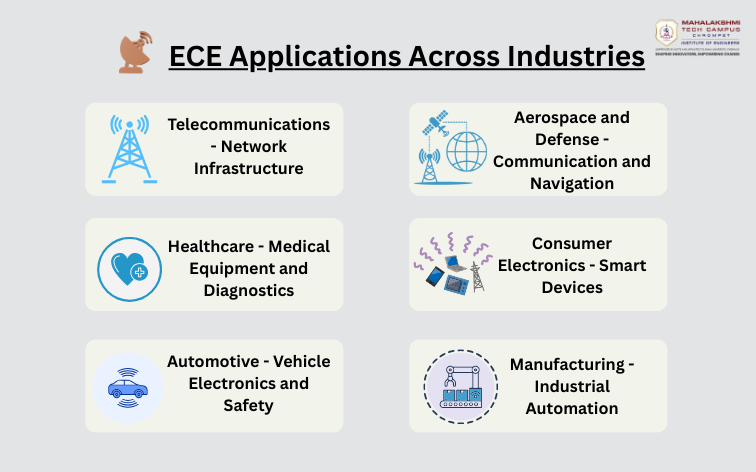
Telecommunications – Network Infrastructure
The telecommunications industry relies completely on ECE for building phone networks, internet services, and data transmission systems. ECE engineers design and maintain the towers, cables, satellites, and equipment that keep billions of people connected worldwide. They develop 4G and 5G networks that give us fast internet on our phones. Without ECE, we wouldn’t have video calls, mobile banking, or instant messaging. The field continuously improves network speed, coverage, and reliability, making communication faster and more accessible to everyone, even in remote areas.
Healthcare – Medical Equipment and Diagnostics
In healthcare, ECE has created life-saving medical devices and diagnostic tools. ECE engineers design MRI machines, CT scanners, X-ray equipment, and ultrasound devices that help doctors see inside the human body. They develop patient monitoring systems that track heart rate, blood pressure, and oxygen levels. Modern pacemakers, hearing aids, and artificial organs all use electronic systems designed by ECE engineers. Telemedicine platforms that let doctors consult patients remotely also depend on ECE technology. These innovations have made healthcare more accurate, accessible, and effective in saving lives.
Automotive – Vehicle Electronics and Safety
The automotive industry has been transformed by ECE through advanced vehicle electronics. Modern cars have dozens of electronic control units that manage engines, brakes, airbags, and entertainment systems. ECE engineers develop GPS navigation systems, parking sensors, backup cameras, and collision detection systems that make driving safer. They work on electric vehicle charging systems and battery management. Self-driving car technology relies heavily on ECE for sensors, cameras, radar systems, and artificial intelligence. These innovations are making vehicles smarter, safer, and more efficient.
Aerospace and Defense – Communication and Navigation
Aerospace and defense sectors depend on ECE for critical communication and navigation systems. ECE engineers design satellite communication systems, radar technology, and secure military communication networks. They develop aircraft navigation systems, flight control electronics, and missile guidance systems. GPS technology that helps us find directions comes from this field. Weather monitoring satellites, space exploration equipment, and drone technology all use ECE principles. These applications ensure national security, enable space missions, and help monitor Earth from space.
Consumer Electronics – Smart Devices
Consumer electronics is the most visible application of ECE in our daily lives. ECE engineers design smartphones, laptops, tablets, smartwatches, and smart home devices. They create the processors, displays, cameras, and wireless connectivity features we use every day. Gaming consoles, smart TVs, digital cameras, and music players are all ECE innovations. Virtual reality headsets, fitness trackers, and home automation systems like smart lights and thermostats come from this field. ECE makes our lives more convenient, entertaining, and connected.
Manufacturing – Industrial Automation
Manufacturing industries use ECE for automation and quality control. ECE engineers design robots that assemble products on factory floors. They create sensors that monitor production processes and detect defects. Programmable logic controllers (PLCs) that run manufacturing equipment are ECE applications. Smart factories use Internet of Things (IoT) devices to track inventory, optimize production, and reduce waste. These technologies have made manufacturing faster, more efficient, and cost-effective while maintaining high quality standards.
Understand ECE vs EEE – Which Branch of Engineering is Better?
What Electronics and Communication Engineers Do?
Electronics and Communication Engineers design, develop, test, and maintain electronic systems and communication networks. They work on creating circuits, analyzing signals, and solving technical problems in devices we use daily. These engineers spend their time in labs testing equipment, using computer software to design circuits, and working with teams to bring new products to life. They read technical documents, write reports, and constantly learn about new technologies. Their work involves both hands-on practical tasks like soldering circuit boards and theoretical work like calculating signal strengths.
What are the Types of Job Roles in ECE field
Electronics and Communication Engineers do more than this… it involves these kinds of roles:
- Electronics Engineer: Designing and developing electronic equipment, components, and systems for various applications
- Communication Engineer: Building and maintaining communication networks, including mobile towers and satellite systems
- Network Engineer: Planning, implementing, and managing computer networks and ensuring smooth data flow
- VLSI Design Engineer: Creating integrated circuits and microchips used in computers and electronic devices
- Embedded Systems Engineer: Developing computer systems built into devices like cars, appliances, and medical equipment
- Signal Processing Engineer: Working on improving signal quality in audio, video, and data transmission
- RF Engineer: Designing radio frequency systems used in wireless communication and broadcasting
- Control Systems Engineer: Creating systems that automatically control industrial processes and machinery
- IoT Engineer: Developing smart connected devices that communicate over the internet
- Telecom Engineer: Managing telephone networks and telecommunication infrastructure
- Hardware Engineer: Designing and testing physical components of electronic devices
- Research and Development Engineer: Investigating new technologies and creating innovative solutions for future products
Top Inventions in ECE Field
There are many inventions involved in the ECE field that changed our world:
- Mobile Phone: A portable communication device that lets us talk, text, browse the internet, and access countless apps from anywhere.
- Internet: A global network that connects billions of computers and devices, enabling instant information sharing and communication worldwide.
- Transistor: A tiny electronic component that acts as a switch or amplifier, forming the building block of all modern electronics.
- Integrated Circuit (Microchip): A small chip containing thousands or millions of electronic components, making computers and smartphones possible.
- Satellite Communication: Technology that uses satellites orbiting Earth to enable long-distance television, phone, and internet services.
- GPS (Global Positioning System): A navigation system using satellites to provide accurate location information anywhere on Earth.
- Television: An electronic device that receives and displays moving images with sound, revolutionizing entertainment and news.
- Computer: An electronic machine that processes data and performs calculations, becoming essential for work, education, and entertainment.
- Wi-Fi: Wireless technology that connects devices to the internet without cables, making connectivity convenient everywhere.
- Bluetooth: Short-range wireless technology that connects devices like headphones, speakers, and phones without wires.
- Digital Camera: A device that captures and stores images electronically, replacing traditional film photography.
Future Trends and Emerging Technologies in ECE
The future of Electronics and Communication Engineering is exciting and full of opportunities:
- 5G and upcoming 6G networks will make internet speeds 100 times faster, enabling new applications we can’t imagine today.
- The Internet of Things (IoT) is connecting billions of devices, from smart homes to entire smart cities, creating a more automated world.
- Artificial Intelligence and Machine Learning are being integrated into ECE systems, making devices smarter and capable of learning from data.
- Edge computing is bringing data processing closer to devices, reducing delays and improving real-time applications.
- Quantum computing promises to solve complex problems that today’s computers cannot handle.
- Wearable technology and biomedical devices are becoming more advanced, helping monitor health continuously.
- Autonomous vehicles are using ECE technology for self-driving capabilities. Renewable energy systems are using smart electronics for efficient power management.
- Augmented Reality and Virtual Reality technologies are creating immersive experiences for gaming, education, and training.
Learn about which engineering course is better for future to identify your aspirations and decide your career path!
Kickstart Your ECE Aspirations with Mahalakshmi Tech Campus
Mahalakshmi Tech Campus in Chennai offers a comprehensive 4-year ECE engineering program designed to prepare you for a successful career in this dynamic field. Affiliated with Anna University and approved by AICTE, we provide quality education with a curriculum that covers all essential concepts and practical skills. Our campus features advanced laboratories, experienced faculty with industry expertise, and modern infrastructure that creates the perfect learning environment. We emphasize hands-on training, industry internships, and project-based learning to ensure you gain real-world experience.